
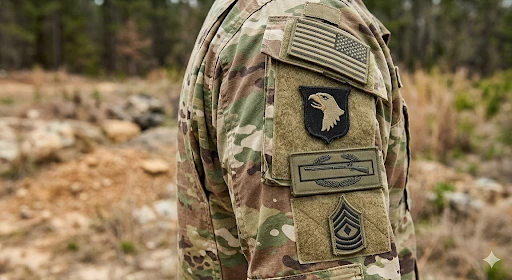
If you have ever seen a soldier in full uniform and wondered what every patch on their sleeve and chest means, you are looking at OCP patches in action.
OCP stands for Operational Camouflage Pattern, the camouflage design used across U.S. Army and Air Force uniforms since it replaced the Army Combat Uniform (ACU) and Air Battle Uniform (ABU). Every insignia stitched, pinned, or velcro’d to that uniform has a precise name, a defined position, and a regulation that governs how it must look.
This guide covers everything you need to know about OCP patches: what they are, the different types worn across military branches, the exact AR 670-1 placement rules, the approved color palette, the difference between embroidered and PVC options, and how to order fully regulation-compliant custom OCP patches for your unit, team, or gear.
Whether you are an active duty soldier needing a replacement patch, a unit leader commissioning a run of morale patches, a veteran building out a collection, or a civilian who wants OCP-style tactical patches on a plate carrier, this is the only guide you need.
What Are OCP Patches?
OCP patches are the patches worn on uniforms that follow the Operational Camouflage Pattern (OCP), also known commercially as Scorpion W2. Adopted by the U.S. Army in 2015 and the U.S. Air Force in 2018 (with full OCP transition standardized by November 1, 2026, per AR 670-1), the OCP uniform is designed to blend into multiple environments, desert, woodland, urban, and snow, using a warm-toned, multi-terrain camouflage palette.
OCP patches serve several distinct functions on the uniform:
- Identification: they tell anyone looking at you exactly who you are, what unit you belong to, and what rank you hold.
- Authorization: they indicate what missions, campaigns, or special qualifications you have earned.
- Morale: command-authorized morale patches build unit cohesion and esprit de corps.
Because the OCP is worn in both garrison and field environments, its patches must conform to subdued color standards that minimize contrast and protect operational security. Full-color patches are not authorized on the OCP utility uniform in most settings.
Types of OCP Patches: A Full Breakdown
There are eight primary categories of patches found on an OCP uniform, each serving a different function and occupying a specific position.
| Patch Type | Who Wears It | Placement on OCP | Backing |
| Unit Patch (SSI) | All Army / Air Force soldiers | Left shoulder sleeve | Velcro |
| U.S. Flag Patch | All Army / Air Force soldiers | Right shoulder (stars forward) | Velcro |
| Combat Patch (SSI-FWTS) | Soldiers w/ wartime service | Right shoulder | Velcro |
| Rank Insignia | All service members | Center chest/collar | Velcro / Sew-on |
| Name Tape | All service members | Above the
right chest pocket |
Velcro |
| Branch Tape (ARMY / AIR FORCE) | All service members | Above left chest pocket | Velcro |
| Skill / Identification Badges | Qualified soldiers | Above the left breast pocket | Velcro / Pin-on |
| Morale Patches | Soldiers (command-authorized) | Chest pocket flap/patrol cap | Velcro |
| Blood Type Patch | Field / tactical operators | Plate carrier/helmet band | Velcro |
1. Unit Patch (Shoulder Sleeve Insignia / SSI)
The unit patch, formally called the Shoulder Sleeve Insignia (SSI), identifies which military unit a soldier belongs to. It is the first patch most people notice on a uniform and is worn on the left shoulder sleeve, centered on the sleeve’s hook-and-loop (velcro) field, one-half inch below the shoulder seam. The design of each SSI is unique to its unit and must be approved by the U.S. Army Institute of Heraldry (TIOH).
For the Air Force, the equivalent patch is worn in the same left sleeve position per AFI 36-2903.
2. U.S. Flag Patch
The U.S. flag patch is worn on the right shoulder sleeve pocket flap of the OCP uniform. A critical rule: the star field must always face forward (toward the front of the body). This reverse-flag orientation is deliberate, it represents the flag being carried into battle, with the stars leading the charge. For field use, the flag patch must use subdued or infrared (IR) reflective versions, not full color.
3. Combat Patch (SSI-FWTS)
Formally designated the Shoulder Sleeve Insignia, Former Wartime Service (SSI-FWTS), the combat patch is one of the most respected pieces of insignia on the Army OCP uniform. It is worn on the right shoulder sleeve below the flag patch, and it represents that a soldier has served in a combat zone under a qualifying unit. In 2022, the Army expanded combat patch eligibility to include additional units and operations. This patch is exclusive to the Army, the Air Force does not wear an equivalent.
4. Rank Insignia, Name Tapes & Branch Tapes
These chest-level patches work together to provide immediate identification of who a service member is and what they do:
- Name Tape: worn above the right chest pocket, displaying the soldier’s last name on a subdued background (typically Coyote Brown on OCP). Standard size is 1 inch x 4.5 inches.
- Branch Tape (e.g., “ARMY” or “AIR FORCE”): worn above the left chest pocket. Same size as the name tape.
- Rank Insignia: worn centered on the chest (or on the collar for junior enlisted), using subdued velcro-backed rank patches. On the OCP, rank uses an OCP pattern or subdued background.
5. OCP Morale Patches
Morale patches are where personality meets the uniform. These informal patches are command-authorized (meaning unit commanders must approve them) and are typically worn on the chest pocket flap, patrol cap, or plate carrier. They must remain within regulation size limits, up to 2 x 3 inches on the chest pocket flap and up to 2 x 2 inches on the patrol cap.
A major policy change in 2019 allowed Air Force Airmen to wear morale patches on their right sleeve, creating a designated OCP morale patch field, something that was not previously authorized. This policy shift significantly increased demand for custom OCP morale patches among Air Force units.
Custom morale patches typically use PVC (rubber) construction with velcro backing, since PVC is waterproof, highly durable, and easy to swap on and off. Embroidered morale patches with velcro backing are equally popular and produce a cleaner, more classic military look.
Pro Tip: Morale Patches in Garrison vs. FieldMorale patches are NOT authorized during formal military occasions, inspections, or in formation. Most units authorize them for daily PT gear, patrol caps on base, or plate carriers in the field when not in an official operational setting. Always confirm with your chain of command before wearing any morale patch.
| Pro Tip: Morale Patches in Garrison vs. Field
Morale patches are NOT authorized during formal military occasions, inspections, or in formation. Most units authorize them for daily PT gear, patrol caps on base, or plate carriers in the field when not in an official operational setting. Always confirm with your chain of command before wearing any morale patch. |
OCP Patch Placement: Army AR 670-1 Quick-Reference Chart
Correct patch placement on the OCP uniform is governed by Army Regulation 670-1 (AR 670-1) and its companion document DA Pamphlet 670-1. These are the single authoritative sources for every placement rule. Getting placement wrong invites uniform corrections and possible disciplinary action, so this quick-reference chart is one you should bookmark.
| Patch / Insignia | Location | Distance / Spec | Auth. Regulation |
| Unit Patch (SSI) | Left shoulder sleeve | 1/2 inch below shoulder seam | AR 670-1 |
| U.S. Flag Patch | Right shoulder sleeve pocket flap | Stars face forward (toward the front) | AR 670-1 |
| Combat Patch (SSI-FWTS) | Right shoulder sleeve | Below the U.S. flag patch | AR 670-1 |
| Rank Insignia | Center of chest (or collar) | Centered on a velcro field | AR 670-1 |
| Name Tape | Above the right chest pocket | Centered on the pocket flap area | AR 670-1 |
| Branch Tape | Above left chest pocket | Centered on the pocket flap area | AR 670-1 |
| Skill Badges | Above the left breast pocket | 1/8 inch above U.S. ARMY tape; stack upward | DA Pam 670-1 |
| Morale Patch | Chest pocket flap or patrol cap | Max 2×3 in. (chest); 2×2 in. (cap) | Chain-of-cmd auth. |
| Blood Type Patch | Plate carrier or helmet band | Front or side; clearly visible | Unit SOP |
For the full Army placement visual with detailed diagrams and measurements, always refer directly to DA Pamphlet 670-1. The tables above reflect the current standard as of 2026.
Air Force OCP Patch Placement (AFI 36-2903)
The Air Force follows its own instruction, Air Force Instruction 36-2903 (AFI 36-2903), which shares much of the logic of AR 670-1 but has some key differences, including the 2019 addition of the authorized right-sleeve morale patch field.
| Patch / Insignia | Location on ABU / OCP | Key AFI 36-2903 Note |
| Unit Patch (OCP) | Left sleeve | Centered on the sleeve pocket velcro field |
| U.S. Flag Patch | Right sleeve (stars forward) | Mandatory on the OCP utility uniform |
| Morale Patch | Right sleeve (OCP morale field) | Authorized since 2019; command approval required |
| Rank Insignia | Center chest | Subdued / OCP-pattern rank |
| Name Tape | Above right chest pocket | Last name; Velcro backing |
| Branch Tape (AIR FORCE) | Above left chest pocket | Velcro; OCP subdued colors |
| Skill / Service Badges | Above left breast pocket | Same precedence stacking rules as Army |
Approved OCP Patch Colors: The Official Subdued Palette
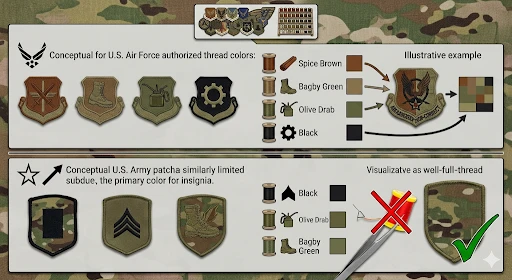
One of the most common mistakes when ordering custom OCP patches is using the wrong colors. The OCP camouflage palette is warm, earthy, and deliberately muted, and your patches must match it. Full-color or high-contrast threads are not authorized for official uniform insignia, and they can result in uniform violations.
The two key regulations here are AR 670-1 for the Army and AFI 36-2903 for the Air Force. The Air Force specifically authorizes four thread colors for unit patches: Spice Brown, Bagby Green, Olive Drab, and Black. The Army follows a similarly limited, subdued palette.
| Color Name | PMS / Reference | Primary Use on OCP Patches |
| Coyote Brown | PMS 498C | Backgrounds, lettering, subdued designs |
| Bagby Green | PMS 578C | Foliage accents, borders, tab lettering |
| Spice Brown | PMS 161C | Unit emblems, text, crest outlines |
| Olive Drab | PMS 399C | Secondary accents, ranger tab-style text |
| Black | PMS Black | Outlines, fine detail, border stitching |
| Sand / Tan | PMS 468C | Backgrounds, low-contrast fill areas |
Note: IR (infrared) reflectance is an additional compliance factor for flag patches and certain operational insignia. Patches used in night-vision or IR environments must have specific IR-reflective or IR-absorptive properties per operational requirements.
Color Compliance Tip for Custom OrdersWhen you order custom OCP patches from The Custom Patches USA, provide us with the Pantone or thread color references listed in the table above. Our design team matches to the exact OCP subdued palette and can produce subdued, IR, or dual-spec (daytime subdued + IR-compliant) versions of any patch design.
| Color Compliance Tip for Custom Orders
When you order custom OCP patches from The Custom Patches USA, provide us with the Pantone or thread color references listed in the table above. Our design team matches to the exact OCP subdued palette and can produce subdued, IR, or dual-spec (daytime subdued + IR-compliant) versions of any patch design. |
Embroidered vs PVC vs Woven OCP Patches: Which Should You Order?
Custom OCP patches are available in three primary construction methods, each with distinct advantages depending on where the patch will be worn and how much punishment it needs to take.
| Feature | Embroidered | PVC / Rubber | Woven |
| Look & Feel | Classic raised thread texture | Bold, 3D molded look | Flat, fine-detail finish |
| Durability | Very high, withstands washing | Extremely high, waterproof | High, thread-tight surface |
| Color Options | OCP subdued thread palette | Full-color or subdued | Fine subdued tones |
| Best For | Uniform insignia, SSI patches | Morale, tactical gear, outdoor | Fine-text name tapes, badges |
| Backing Options | Velcro, sew-on, iron-on | Velcro (standard), sew-on | Velcro, sew-on |
| Weight | Lightweight | Heavier than embroidered | Lightest option |
| Minimum Order (typical) | 10–25 pieces | 10–25 pieces | 25–50 pieces |
| OCP Compliance | Yes, regulation colors | Yes, subdued versions available | Yes, regulation colors |
Custom Embroidered OCP Patches
Embroidered OCP patches are the traditional standard for military insignia. High stitch density, reinforced merrowed or laser-cut borders, and thread colors precisely matched to OCP-approved hues make embroidered patches the first choice for official unit insignia, SSI patches, and skill badges. They are lightweight, machine-washable, and produce crisp detail at regulation sizes.
At The Custom Patches USA, our custom embroidered patches are available with velcro backing as standard, making them drop-in compatible with every velcro field on the OCP uniform. Minimum order starts at 10 pieces.
Custom PVC OCP Patches
PVC (polyvinyl chloride) rubber patches are the go-to choice for OCP morale patches and tactical gear patches. They are 100% waterproof, resistant to abrasion and UV fading, and hold molded 3D detail that embroidery cannot replicate. PVC patches are the most popular format for custom morale patches, blood type patches, and tactical identifier patches worn on plate carriers and helmet bands.
Our custom PVC patches come standard with loop-side velcro backing and are available in subdued OCP color palettes or custom full-color versions for off-uniform uses.
Custom Woven OCP Patches
Woven patches use a tight, flat weave process that allows for fine text and intricate line art at sizes where embroidery would lose clarity. They are ideal for name tapes, specialty badges, and precision-text insignia. Our custom woven patches are produced in the full OCP-approved subdued palette and are available with velcro or sew-on backing.
How to Attach OCP Patches: Velcro, Sew-On & Iron-On Explained
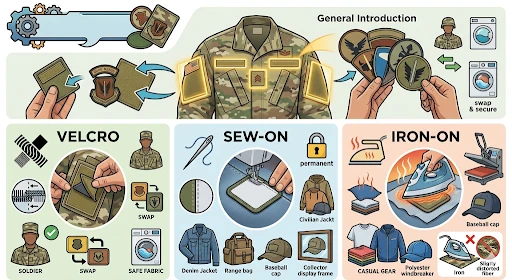
The OCP uniform has integrated hook-and-loop (velcro) panels at every authorized patch location, both sleeves, both chest pockets, and the rank position. This means velcro-backed patches are the standard for virtually all OCP uniform patches. Here is how the three main attachment methods compare for OCP use:
Velcro (Hook-and-Loop) Backing, The OCP Standard
Velcro-backed OCP patches are the correct choice for any patch that will be worn directly on the OCP uniform. The uniform’s integrated loop fields hold hook-backed patches securely through the rigors of field use while allowing patches to be swapped when a soldier transfers units or removes insignia for laundry. Iron-on backing is not recommended for military OCP uniforms, the heat required for application and removal can damage the OCP fabric’s coating.
Sew-On Backing — For Permanent Applications
In the sew-on vs iron-on patches comparison, sew-on patches are appropriate for permanent applications, civilian jackets, range bags, custom headwear, or collector items where you will never need to swap the patch out. Our sew-on patches use reinforced backing fabric with a clean edge for clean stitching lines. For uniform use, sew-on is less common precisely because the OCP is designed for velcro swapping.
Iron-On Backing — For Civilian / Casual Gear Only
Iron-on backing uses a heat-activated adhesive that bonds the patch to fabric under an iron or heat press. It works well on cotton and polyester civilian clothing, jackets, and caps. Our iron patches are a convenient option for fans, collectors, and civilians who want OCP aesthetic patches on everyday clothing. For any OCP uniform application, however, stick with Velcro.
Custom OCP Patches: How to Order the Right Patch for Your Unit or Gear
Whether you need a run of custom unit SSI patches for a company transfer, a batch of OCP morale patches for your team, or a single replacement name tape, getting the right specs the first time saves time and money. Here is what to finalize before you place an order:
Step 1 — Define Your Patch Type and Function
Are you ordering official unit insignia (must comply with AR 670-1 / AFI 36-2903), or morale / off-uniform tactical patches (more design freedom, but still subdued palette for OCP wear)? This determines the color constraints, size limits, and whether you need velcro or sew-on backing.
Step 2 — Choose Your Material
Use the comparison table above to select between embroidered, PVC, and woven. As a quick guide:
- Official unit patches, name tapes, skill badges → embroidered or woven with velcro backing
- Morale patches, plate carrier patches, helmet band patches → PVC with velcro backing
- Collector pieces, jacket patches, range bag patches → embroidered or PVC with sew-on or iron-on
Step 3 — Specify Your OCP-Compliant Color Palette
Reference the color table above and specify thread or PVC colors using Pantone references. For official insignia, stick to Coyote Brown, Bagby Green, Spice Brown, Olive Drab, and Black. Request a digital proof before approving production. This is especially important for unit SSI patches where the design must match the TIOH-approved design.
Step 4 — Confirm Size Against Regulation
Standard OCP patch size references:
- SSI (Unit Patch): approximately 2.5 to 3 inches across
- S. Flag Patch: approximately 2 x 3 inches
- Name Tape / Branch Tape: 1 inch x 4.5 inches
- Chest Pocket Flap Morale Patch: maximum 2 x 3 inches
- Patrol Cap Morale Patch: maximum 2 x 2 inches
- Helmet Band Patch: maximum 2 x 2 inches
Always verify against the current AR 670-1 or AFI 36-2903 for your branch before finalizing your order.
Step 5 — Set Your Quantity and Turnaround Requirements
The Custom Patches USA accepts orders with a minimum of 10 pieces for embroidered and PVC patches. Bulk unit orders (100+ pieces) receive volume pricing. Rush turnaround is available, contact our team for lead time quotes on urgent military orders.
Free Design Service Included Every custom OCP patch order at The Custom Patches USA includes free artwork and design service. Our team will digitize your design, match your thread colors to the OCP subdued palette, and provide a digital proof before production begins, at no extra charge. Free shipping on all orders.
| Free Design Service Included
Every custom OCP patch order at The Custom Patches USA includes free artwork and design service. Our team will digitize your design, match your thread colors to the OCP subdued palette, and provide a digital proof before production begins, at no extra charge. Free shipping on all orders. |
Can Civilians Wear OCP Patches? What You Need to Know
This is one of the most searched questions around OCP patches, and the answer is nuanced. Official military insignia, rank, unit SSI, and combat patches are restricted to authorized military personnel. Wearing official military rank or unit patches while impersonating a service member is a violation of federal law (18 U.S.C. § 704).
However, civilian use of OCP-style patches is very common and fully legal in the following contexts:
- Morale patches: civilians, airsoft players, preppers, hikers, and tactical gear enthusiasts widely wear OCP aesthetic morale patches on backpacks, jackets, range bags, and plate carriers.
- Custom team patches: law enforcement, security contractors, hunting clubs, and outdoor organizations frequently order OCP-compliant custom patches for their gear.
- Veteran collections: veterans collecting their service patches or building replica setups of their own service gear are not impersonating anyone.
- Airsoft and milsim: the milsim community is one of the largest civilian markets for OCP PVC morale patches and unit-style patches.
If you want OCP aesthetic patches for non-military civilian use, custom PVC morale patches are the most popular choice. For uniform-adjacent uses like law enforcement or security contractor gear, our custom embroidered patches can be produced in fully OCP-compliant subdued colors with your own organization’s design.
OCP Patches vs. ACU, MultiCam, and Scorpion OCP: What’s the Difference?
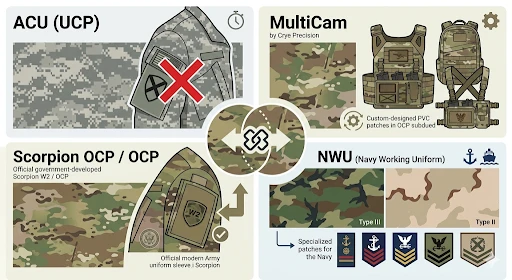
Confusion around OCP patches often comes from the relationship between several closely related terms. Here is a clear breakdown:
- ACU (Army Combat Uniform): the predecessor to OCP, featuring the grey-toned Universal Camouflage Pattern (UCP). ACU patches used a different color palette, grey, sage green, and black, and are no longer the standard uniform.
- MultiCam: the commercial name for the camouflage pattern developed by Crye Precision. The Army evaluated MultiCam in Afghanistan before adopting Scorpion W2 (OCP) as the official standard. MultiCam and OCP are visually very similar, and patches designed for MultiCam gear (plate carriers, backpacks) typically work aesthetically with OCP uniforms.
- Scorpion W2 / Scorpion OCP: the official government-developed pattern used on the current OCP uniform. When someone says “OCP patches” for official uniform use, they mean patches made to the Scorpion W2 color standard.
- NWU (Navy Working Uniform): The Navy uses its own woodland and desert patterns, patches for NWU Type II/III follow Navy-specific regulations and are different from Army/Air Force OCP patches.
If you are ordering patches for MultiCam plate carriers, ruck sacks, or assaulter gear, our custom PVC patches in OCP subdued tones are fully compatible across OCP, Scorpion W2, and MultiCam-pattern gear.
6 Common OCP Patch Mistakes (And How to Avoid Them)
Even experienced service members run into OCP patch problems. Here are the six most common mistakes, and how to avoid each one:
- Using full-color patches on the OCP uniform: Full-color patches are not authorized on the OCP utility uniform in most settings. Always order subdued versions for uniform wear.
- Wrong flag orientation: The stars on the U.S. flag patch must always face forward (toward the front of the body). Stars facing rear is an unauthorized orientation and a common rookie error.
- Placing patches without velcro alignment: The hook side of your patch must align squarely with the loop field sewn into the uniform. Off-angle patches drift and look unprofessional. Align center-to-center.
- Ordering oversized morale patches: Chest pocket flap morale patches have a strict 2 x 3-inch maximum. Patrol cap morale patches are limited to 2 x 2 inches. Measure before ordering.
- Wearing morale patches in unauthorized environments: Morale patches require chain-of-command authorization and are not appropriate for formation, inspections, or official ceremonies.
- Incorrect thread colors on custom designs: Using high-contrast or non-OCP colors on custom patches makes them stand out against the camouflage and marks you as non-compliant. Match the subdued palette. And also choosing the right Merrowed Edge vs Laser Cut Border in accordance with the thread colors
Frequently Asked Questions
What does OCP stand for in OCP patches?
OCP stands for Operational Camouflage Pattern, the multi-terrain camouflage design used on current U.S. Army and Air Force utility uniforms. OCP patches are all patches worn on or designed for OCP-pattern uniforms and gear.
Where does the unit patch go on an OCP uniform?
The unit patch (Shoulder Sleeve Insignia / SSI) is worn on the left shoulder sleeve, centered on the hook-and-loop velcro field, one-half inch below the shoulder seam. This applies to both Army and Air Force OCP uniforms.
Where does the flag patch go on an OCP uniform?
The U.S. flag patch is worn on the right shoulder sleeve pocket flap of the OCP uniform. The star field must always face forward (toward the front of the body), which results in the flag appearing in reverse orientation. Subdued or IR-reflective versions are required for field use.
Can you wear full-color patches on OCP?
No. Full-color patches are not authorized on the OCP utility uniform in most contexts. All OCP patches must use subdued colors from the approved palette, Coyote Brown, Bagby Green, Spice Brown, Olive Drab, and Black. Full-color patches may be authorized on specific dress or service uniforms in garrison settings, but check AR 670-1 for your specific situation.
What is a combat patch on OCP?
The combat patch is formally the Shoulder Sleeve Insignia, Former Wartime Service (SSI-FWTS). It is worn on the right shoulder of the OCP uniform by soldiers who have served in a combat zone under a qualifying unit. It is an Army-exclusive patch, the Air Force does not have an equivalent.
What size should OCP patches be?
Patch size depends on location and type. SSI (unit patches) are approximately 2.5 to 3 inches across. The U.S. flag patch is approximately 2 x 3 inches. Name tapes are 1 inch x 4.5 inches. Chest pocket flap morale patches are limited to 2 x 3 inches. Patrol cap morale patches are limited to 2 x 2 inches. Always verify against the current AR 670-1 or AFI 36-2903.
What backing is used for OCP uniform patches?
Velcro (hook-and-loop) backing is the standard for all OCP uniform patches. The OCP uniform has integrated loop-side velcro panels at every authorized patch location. Iron-on backing is not recommended for military OCP uniforms as heat can damage the fabric. Sew-on backing is used for permanent applications on civilian or collector items.
Can civilians buy and wear OCP patches?
Civilians can legally buy and wear OCP morale patches on backpacks, jackets, and gear. What is not legal is wearing official military rank insignia or impersonating a service member. Civilian uses, airsoft, tactical hobbies, collector setups, and outdoor gear are fully common and legal.
What are OCP morale patches?
OCP morale patches are informal patches that express unit identity, humor, or personal pride. They are authorized by unit commanders and worn on designated areas such as the chest pocket flap, patrol cap, or plate carrier. Since 2019, Air Force Airmen may also wear morale patches on the right sleeve of their OCP uniform. PVC with velcro backing is the most popular format.
What thread colors are approved for OCP patches?
The approved thread colors for OCP patches include Coyote Brown (PMS 498C), Bagby Green (PMS 578C), Spice Brown (PMS 161C), Olive Drab (PMS 399C), Black (PMS Black), and Sand/Tan (PMS 468C). The Air Force specifically authorizes Spice Brown, Bagby Green, Olive Drab, and Black for unit patches under AFI 36-2903.
What is the difference between OCP and MultiCam patches?
OCP refers to the official U.S. military Operational Camouflage Pattern (Scorpion W2), while MultiCam is the commercial name for Crye Precision’s similar pattern. Patches designed for MultiCam gear are visually compatible with OCP, and many suppliers use the terms interchangeably for morale and tactical patches. For official uniform insignia, OCP-specific subdued colors apply.
How many OCP patches can you wear at once?
There is no single “number” limit, but every patch has a specific authorized location, and only one patch can occupy each location. You can wear one unit SSI (left sleeve), one flag patch (right sleeve), one combat patch (right sleeve, below flag), name and branch tapes, rank, skill badges, and one authorized morale patch, each in its designated location. Unauthorized locations or stacking are not permitted.
Can I put OCP patches on a hat or backpack?
Yes. PVC and embroidered OCP-style patches with velcro or iron-on backing are widely used on patrol caps, tactical backpacks, range bags, plate carriers, and civilian jackets. The Custom Patches USA produces patches for all of these applications. For patrol cap placement on the OCP uniform, the morale patch must not exceed 2 x 2 inches and must be command-authorized.
How do I order custom OCP patches for my unit?
Contact The Custom Patches USA via thecustompatchesusa.com with your unit’s design artwork (or a description of what you need), preferred size, quantity, and color references from the OCP-approved palette. Our team provides a free digital proof, matches your colors to OCP-compliant thread or PVC specifications, and ships free within the USA. Minimum order is 10 pieces.
Everything About OCP Patches in One Place
OCP patches are far more than decorative embellishments on a military uniform. Each one tells a story, your unit, your rank, your service, your mission, and your character. Understanding the types, placement rules, approved color standards, and material options puts you in control of every patch decision you make, whether you are a soldier staying compliant with AR 670-1, a unit leader ordering a run of morale patches, or a civilian building out your tactical kit.
To recap the essentials: OCP patches use a subdued, warm-toned palette dominated by Coyote Brown, Bagby Green, Spice Brown, Olive Drab, and Black. Velcro backing is the universal standard for uniform wear. Placement is governed by AR 670-1 for the Army and AFI 36-2903 for the Air Force. Embroidered patches are best for official insignia, PVC for morale and tactical gear, and woven for fine-detail name tapes and badges.
Ready to order? The Custom Patches USA produces fully OCP-compliant custom patches, embroidered, PVC, and woven, with free design service, free shipping, and a 10-piece minimum. Get your free quote today and let our team help you get every detail right the first time.