
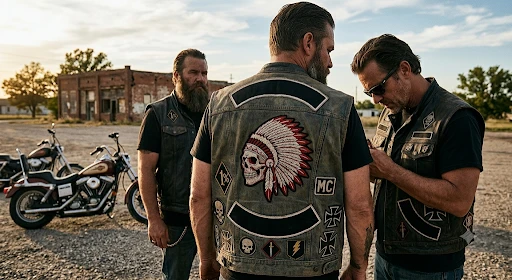
Every patch on a biker’s vest tells a story. For decades, motorcycle club patches have worked as a visual language, communicating rank, loyalty, territory, and identity before a single word is spoken.
Few names are more closely tied to this culture than the Hells Angels, whose winged skull emblem is recognized around the world as a symbol of outlaw motorcycle club history.
This guide breaks down the meaning, history, culture, and symbolism behind motorcycle club patches, including how the three piece patch system works, what the 1% patch really means, how club colors are earned, and how skilled embroiderers recreate that same craftsmanship for riding clubs, veteran groups, and brands that want an authentic look built on their own original artwork.
What Are Motorcycle Club Patches?
Motorcycle club patches, often called colors, are embroidered or woven patches worn on the back of a member’s vest, known as a cut or cutter. In simple terms, a motorcycle club patch tells other riders who a person rides with, what club they belong to, and where that club is based.
Members earn the right to wear these patches through a structured process rather than buying them off a shelf, which is what separates a true motorcycle club, shortened as MC, from a casual riding club, shortened as RC, or a social riding group that rides for fun without the same hierarchy or territorial rules.
A Brief History of Motorcycle Club Patches and the 1%er Label
The story of modern motorcycle club patches traces back to 1947, when a large gathering of riders in Hollister, California drew national attention after a small number of attendees caused disturbances in town.
In the aftermath, the American Motorcyclist Association is widely reported to have stated that 99 percent of motorcyclists were law abiding citizens, implying that a small minority fell outside that description.
Rather than distance themselves from the label, some clubs embraced it, and the term one percenter, or 1%er, became a defining identity within a segment of motorcycle culture.
To visually separate themselves from AMA sanctioned clubs that wore a single patch, these outlaw motorcycle clubs began wearing their emblem split into three separate pieces, a format that is still recognized today as the three piece patch.
How the Hells Angels Shaped Global MC Culture
The Hells Angels Motorcycle Club is one of the most recognized names in this history. It was founded in 1948 in San Bernardino, California, largely by riders looking for camaraderie on the road in the years following the Second World War.
Over the following decades, the club expanded into chapters across the United States and into other countries, and its winged skull design, commonly called the Death Head, became one of the most identifiable emblems in motorcycle culture.
Because the Hells Angels name and emblem are protected trademarks belonging to the club, this guide does not reproduce or offer to recreate that specific artwork.
What it does cover is the broader system of patch meanings, structure, and symbolism that grew out of this era of motorcycle club history, along with how the same embroidery techniques are used today to build original, legally sound patch designs for riding clubs, veteran associations, and brands.
The Three-Piece Patch Explained: Top Rocker, Center Patch, Bottom Rocker
The three piece patch is the most recognized format in traditional motorcycle club culture. It is made up of three separate embroidered patches arranged on the back of the cut, and together they are referred to as a member’s colors.
| Patch Element |
Position |
What It Represents |
| Top Rocker | Curved patch above the center emblem | The name of the motorcycle club |
| Center Patch | Middle of the back | The club’s main emblem, crest, or mascot |
| Bottom Rocker | Curved patch below the center emblem | The chapter, city, or territory the member represents |
One-Piece vs Two-Piece vs Three-Piece Patches
Not every rider wears the same patch format, and the number of pieces on a vest signals a very different level of membership and structure.
| Patch Type | Structure | Typical Meaning |
| One-Piece Patch | Single emblem with club name and logo combined | Common for AMA sanctioned clubs and casual riding groups with no territorial claims |
| Two-Piece Patch | Top rocker plus a center emblem, no bottom rocker | Often used by a club working toward full charter status or approval from a dominant regional club |
| Three-Piece Patch | Top rocker, center patch, and bottom rocker | The traditional format for a fully chartered motorcycle club, reserved for patched, full members |
Common Motorcycle Patch Symbols and Their Meanings
Beyond the main back patch, riders collect a range of smaller patches, and each one carries its own meaning within motorcycle club culture.
| Symbol or Patch | Common Meaning |
| 1% Diamond | Signals affiliation with a club that considers itself outside mainstream, AMA sanctioned riding culture |
| MC Block Letters | Confirms the group operates as a traditional motorcycle club rather than a riding or social club |
| Officer Titles (President, Vice President, Sergeant-at-Arms, Road Captain) | Denotes a specific leadership role within the club’s hierarchy |
| Prospect Rocker | Worn by a member in a probationary period before full patch status is earned |
| Territory or City Rocker | Marks the specific region or chapter a member is claiming and representing |
| Memorial or RIP Patch | Honors a deceased club member and their years of service |
| Years of Service Patch | Marks a milestone of long term, loyal membership within the club |
What Do Motorcycle Patch Colors Symbolize?
Color choice matters just as much as the design itself. Many traditional clubs favor bold, high contrast combinations such as black and white or black and red because they read clearly from a distance and hold up over years of wear.
A club’s chosen colors become part of its identity in the same way a company logo builds brand recognition, which is why consistent thread color matching matters whether a patch is being made for a motorcycle club, a corporate uniform, or a school organization.
Motorcycle Club Patch Etiquette: Unwritten Rules Every Rider Should Know
Patch etiquette is taken seriously across motorcycle club culture, and understanding it helps explain why these emblems carry so much weight.
- A three piece patch is earned through membership and time, not purchased or worn casually.
- Touching another member’s colors without permission is widely considered a serious act of disrespect.
- A bottom rocker claims territory, and displaying one without approval from the dominant local club can create real conflict.
- Wearing a patch, rank title, or rocker that has not been earned is viewed as a significant breach of etiquette.
- Prospecting periods exist so a club can evaluate loyalty and commitment before awarding full colors.
The Craftsmanship Behind Authentic-Style MC Patches
The bold, textured look associated with classic biker back patches comes down to embroidery technique. Dense stitch coverage, a sturdy twill backing, and a clean merrowed edge give a rocker or center patch the raised, three dimensional finish that has defined vest patches for generations.
This same craftsmanship overlaps with the techniques used on military patches, where unit identity and earned rank carry a similarly layered history within uniformed culture.
Full sized back patches are usually produced through custom embroidered patches, which hold up well to years of riding, weather, and washing. For designs with fine text or intricate line work, custom woven patches offer a flatter, more detailed finish, while custom chenille patches bring a raised, letterman style texture that some clubs and riding groups prefer for smaller emblems and memorial patches.
Custom Motorcycle Patches for Riding Clubs, Veteran Groups, and Brands
Plenty of riders want the same bold, earned look of a traditional MC patch for a legitimate riding club, a veteran motorcycle association, a charity ride, or an apparel brand, built entirely around original artwork rather than any existing club’s protected emblem.
Choosing between sew on patches and iron patches usually comes down to how the patch will be used, a decision covered in more depth in this breakdown of sew on versus iron on embroidered patches.
How to Order Custom Motorcycle-Style Patches
- Share a logo, sketch, or rough concept along with the size and quantity needed.
- Receive a free digital proof to review layout, thread colors, and border style before production starts.
- Approve the proof and choose a backing option, such as sew on, iron on, or hook and loop.
- Production begins using premium embroidery thread and a durable twill backing.
- Finished patches are packaged and shipped, ready to be sewn onto a cut, jacket, or vest.
Frequently Asked Questions About Motorcycle Club Patches
What do the three patches on a motorcycle vest mean?
The three patches, known together as the three piece patch, show the club name on the top rocker, the club emblem on the center patch, and the chapter or territory on the bottom rocker. Together they represent full, earned membership in a chartered motorcycle club.
What does the 1% patch mean?
The 1% patch, usually shown as a diamond containing the number 1%, traces back to the 1947 Hollister rally and the idea that a small minority of riders fell outside mainstream, AMA sanctioned motorcycle culture. Clubs that wear it identify as outlaw motorcycle clubs, separate from AMA sanctioned riding organizations.
Can anyone buy a three-piece motorcycle club patch?
No. A genuine three piece patch is earned through a club’s membership process, often including a prospecting period, rather than purchased. Wearing one without earning it is considered a serious violation of motorcycle club etiquette.
What is the difference between an MC and a riding club (RC)?
An MC, or motorcycle club, typically has a defined hierarchy, a prospecting process, and territorial rules tied to its patch. A riding club, or RC, is generally more casual, focused on group rides and community rather than rank, structure, or claimed territory.
Why is the Hells Angels emblem so widely recognized?
The Hells Angels Motorcycle Club was founded in 1948 and grew into one of the largest and most visible motorcycle clubs in the world. Its winged skull design became closely tied to the broader image of outlaw motorcycle club history, which is one reason the club and its emblem are so widely known today.
What does a ‘property of’ patch mean?
A property of patch signals a personal connection to a specific club member or the club itself. Its use and meaning vary by club, and outside the community it is best understood simply as a patch style with cultural significance rather than something to reproduce casually.
Is it legal to wear a motorcycle patch you have not earned?
Wearing an unearned patch is not typically a criminal matter, but it is treated as a serious social violation within motorcycle club culture and can lead to real conflict. Reputable custom patch makers also avoid reproducing another club’s protected emblem out of respect for trademark rights.
How are custom motorcycle-style patches made today?
Modern back patches and rockers are produced using digitized embroidery files, dense thread coverage, and a merrowed or laser cut border, then finished with a sew on, iron on, or hook and loop backing depending on how the patch will be worn.
Riding Forward: The Legacy of Motorcycle Club Patch Culture
From the aftermath of the 1947 Hollister rally to the global recognition of the Hells Angels emblem, motorcycle club patches have grown into one of the most meaningful symbol systems in American subculture. The top rocker, center patch, bottom rocker, and every smaller emblem in between tell a story of loyalty, hierarchy, and earned respect built up over decades.
That same spirit of craftsmanship and identity now extends to riding clubs, veteran groups, and brands building their own original patch designs, proving that the language of colors, rockers, and embroidered emblems is still very much alive on the open road.
If you are interested in bold and catchy motorcycle patches, then head over to The Custom Patches USA and get your riding gear ready.